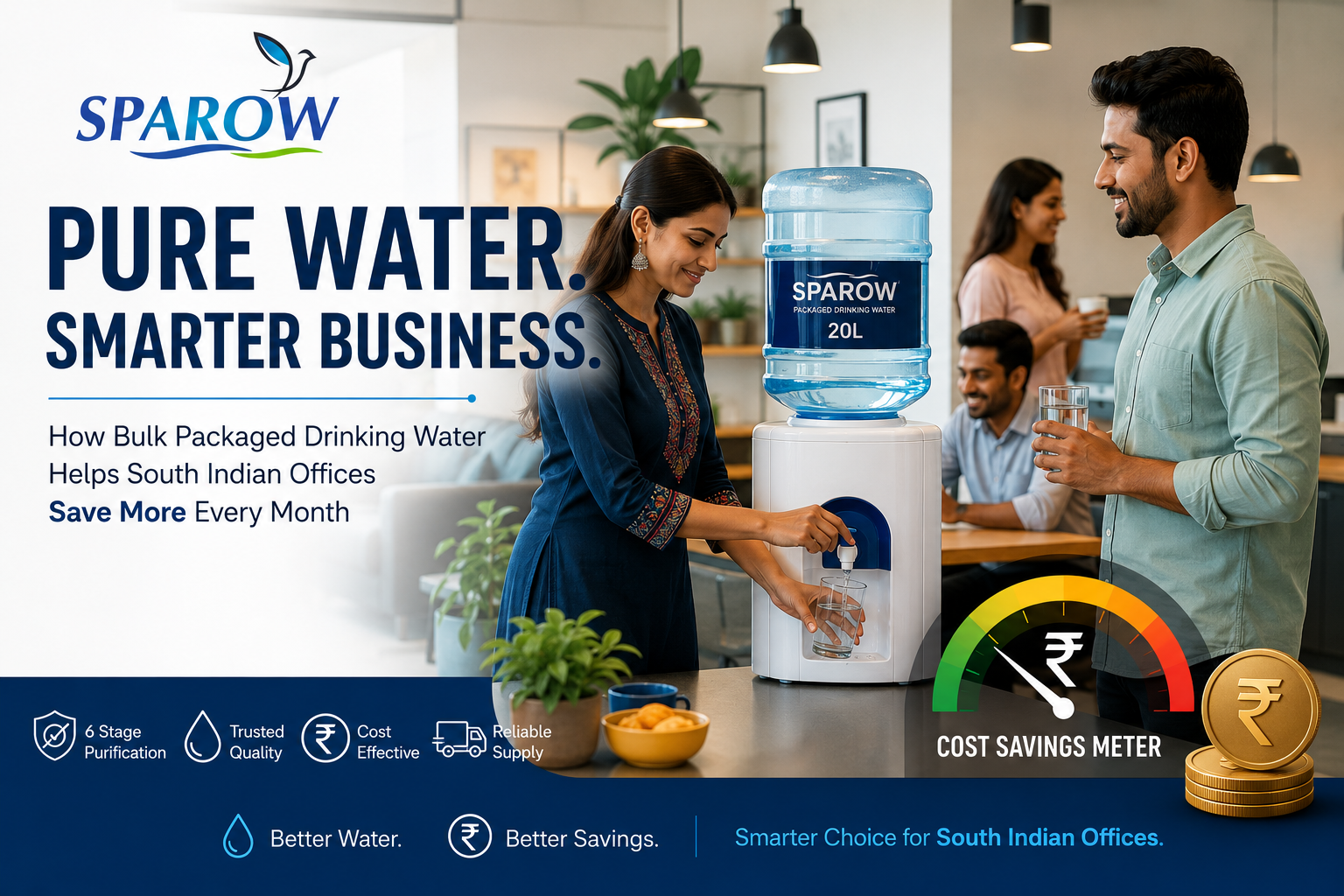
Are you constantly running out of drinking water at work? Perhaps your company in Madurai or Tirunelveli is overspending on endless 20-litre bubble top can deliveries that clutter the pantry. Managing workplace hydration shouldn’t be a frustrating guessing game for facility managers.
Without a clear strategy, businesses either face unhappy, dehydrated employees or drastically overpay for services they don’t fully use. That is exactly why we created this definitive office water consumption guide tailored specifically for South Tamil Nadu.
By the end of this article, you will know exactly how many litres of water your team needs daily. You will also learn how to choose the most cost-effective commercial RO system to combat local hard water issues. Let’s optimize your pantry, cut overhead costs, and keep your staff healthy.
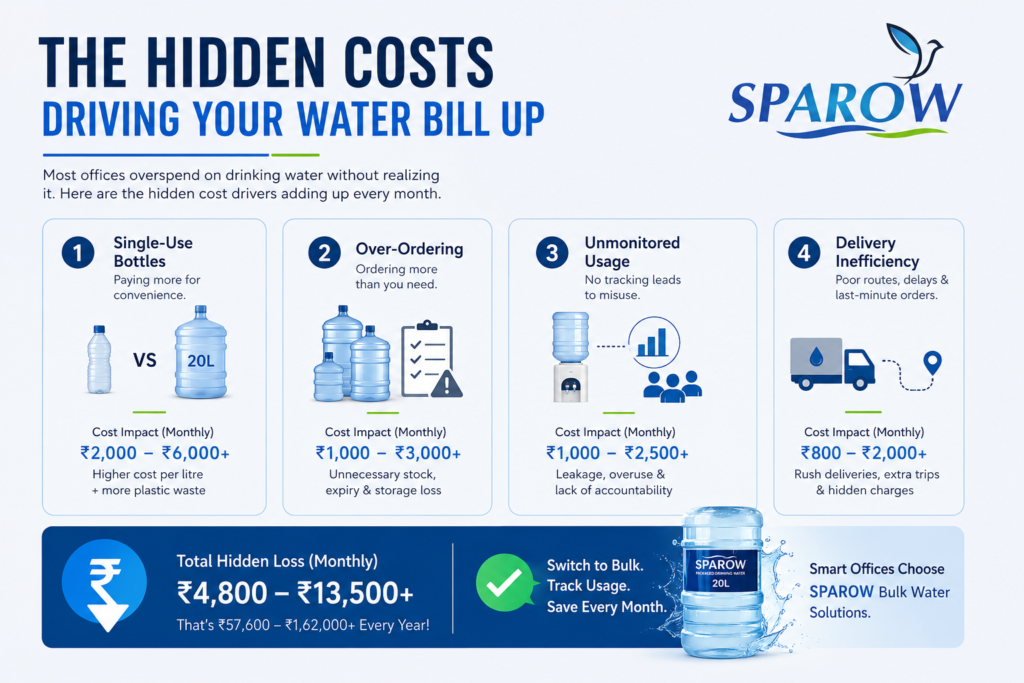
Table of Contents
Why Every Workplace Needs an Office Water Consumption Guide
Many office managers treat drinking water as an afterthought. They sign a verbal contract with a local water can vendor and simply pay the monthly invoices. However, ignoring this vital utility is a fast track to severe budget leakage.
A formal office water consumption guide acts as a blueprint for your facility operations. It helps you track usage patterns, monitor expenses, and ensure compliance with occupational health standards. Having a documented strategy prevents sudden shortages during the sweltering Kathiri Veyil (peak summer) months.
Furthermore, a predictable consumption plan streamlines your accounting. You can accurately forecast your quarterly facilities budget without unexpected spikes. It makes corporate facility management much easier and far more professional.
The Hidden Costs of Guessing
When you guess your water needs, you risk chronic over-ordering. Those heavy 20-litre cans take up valuable real estate in your pantry or storage closets. Stagnant water can also become a health liability if left sitting for too long in hot temperatures.
Conversely, under-ordering causes immediate frustration among your staff. An empty water cooler sends a poor message about company culture. It forces staff to leave the building to buy bottled water, wasting valuable working hours.
Calculating Your Needs: The Standard Litre Formula
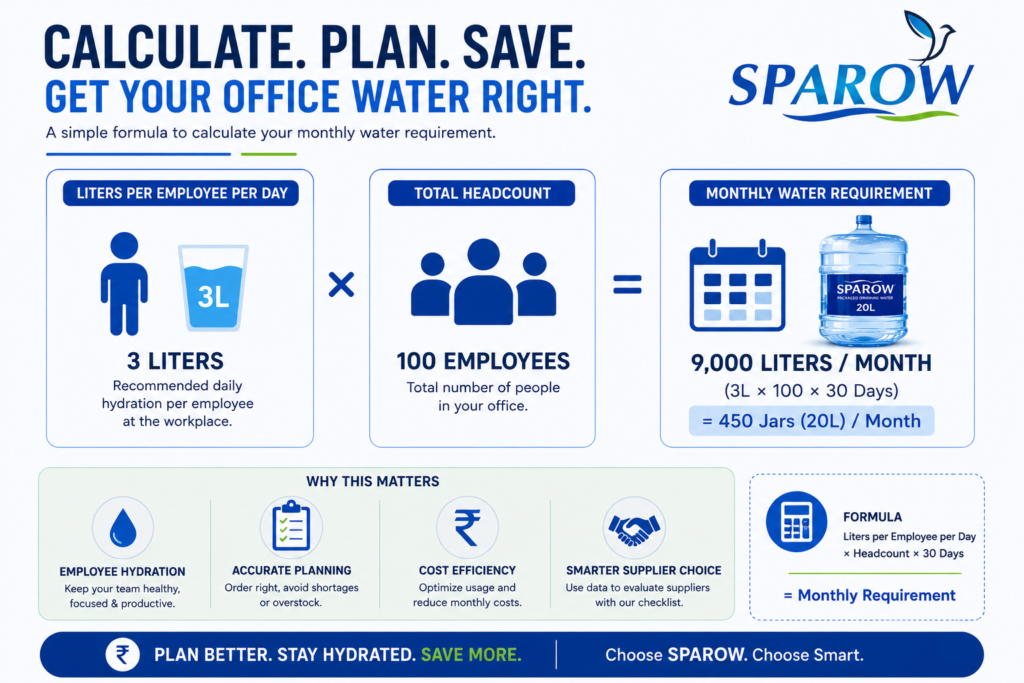
Data-driven decisions always beat estimations. To master your breakroom budget, you need to apply a reliable formula. This formula is the cornerstone of any effective office water consumption guide.
Given the extreme tropical climate in South Tamil Nadu, standards dictate that the average office worker drinks about 2 to 3 litres of water during an eight-hour shift. However, this base metric is just the starting point.
To find your baseline daily volume, multiply your employee headcount by 2.5 litres. For a team of 50 people, your baseline is 125 litres per day. Next, you must account for indirect water usage.
Factoring in Filter Coffee, Chai, and Guests
Employees do not just drink cold water from the dispenser. The office pantry relies heavily on purified water to brew fresh filter coffee, make evening chai, and prepare instant meals. You must factor this indirect consumption into your final calculations.
We recommend adding a flat 20% buffer to your baseline total. If your baseline is 125 litres, add 25 extra litres to cover hot beverages and visiting clients. Therefore, your 50-person office needs 150 litres of purified water daily.
Here is a quick reference table for daily consumption based on office size:
| Office Size | Baseline Daily Need | 20% Buffer Included | Monthly Total (22 Work Days) | Estimated 20L Cans/Month |
|---|---|---|---|---|
| 10 Employees | 25 Litres | 30 Litres | 660 Litres | ~33 Cans |
| 25 Employees | 62.5 Litres | 75 Litres | 1,650 Litres | ~83 Cans |
| 50 Employees | 125 Litres | 150 Litres | 3,300 Litres | ~165 Cans |
| 100 Employees | 250 Litres | 300 Litres | 6,600 Litres | ~330 Cans |
Variables That Impact Daily Intake in South Tamil Nadu
Not all workplaces consume liquids at the same rate. An air-conditioned IT park in Madurai will have slightly different needs than a naturally ventilated manufacturing unit in Virudhunagar or Sivakasi. The local micro-climate plays a massive role in human hydration requirements.
If your office lacks central AC or involves physical labor, increase your baseline significantly. Workers in unconditioned warehouses in coastal areas like Thoothukudi sweat heavily due to high humidity. In these environments, consumption can easily reach 3.5 to 4 litres per person.
A truly customized office water consumption guide requires you to assess your unique company environment. Always prioritize employee health over strict rationing.
The Hidden Costs of Poor Hydration
Supplying clean water is not just a budget line item; it is an investment in human capital. The human brain is composed of roughly 73% water. Even mild dehydration can severely impact cognitive function.
When employees do not drink enough water, their concentration plummets. They experience mid-afternoon fatigue, mood swings, and reduced problem-solving abilities. This directly harms your company’s daily output and bottom line.
Employee Productivity Drops
Studies show that a mere 2% drop in hydration levels can lead to a 20% decrease in cognitive performance. Tasks take longer to complete, and error rates increase. Workers struggle to maintain focus during long meetings or complex computer tasks.
Providing easy access to fresh, great-tasting water encourages constant sipping. This steady intake keeps energy levels stable throughout the afternoon slump. It is a highly cost-effective way to boost overall office productivity.
Health and Absenteeism
Chronic mild dehydration leads to frequent headaches and weakened immune responses. This translates directly into higher rates of employee absenteeism. Sick days cost businesses thousands of rupees annually in lost labor.
A well-hydrated workforce simply takes fewer sick days. By following a structured office water consumption guide, you proactively protect your team’s health. It is a preventative wellness measure that yields massive dividends.
Tackling Hard Water: Types of Office Water Systems
Knowing how many litres you need is only half the battle. You must also determine the best delivery method for your specific floor plan and local water quality. In South Tamil Nadu, groundwater TDS (Total Dissolved Solids) levels are a major challenge.
Managing daily vendor schedules for your corporate pantry can quickly become a logistical nightmare for facility managers. If you are exhausted by the hidden costs, inconsistent hygiene, and frequent delays associated with traditional office water delivery services , it is time to make a smarter switch. Reach out to our dedicated support team today, and let us help you seamlessly transition to a cost-effective, high-capacity commercial RO system tailored for your specific needs.
Areas in South Madurai, Tirunelveli, and Kanyakumari often report borewell TDS levels ranging from 1,000 to over 3,000 mg/litre. Your choice of water system must be able to handle this hard water effectively.
20-Litre Water Can Delivery Services
This is the traditional model where a vendor delivers heavy 20-litre plastic cans (bubble tops). It is incredibly easy to set up because it requires no plumbing. You simply place the can on a standard dispenser.
However, this method is often the most expensive over the long term and creates massive logistical headaches. You pay a premium for the physical delivery and the vendor’s margins. Furthermore, trusting the hygiene standards of unbranded local water suppliers in tier-2 cities can sometimes be risky.
Commercial RO Water Purifiers (Bottleless)
Point-of-Use (POU) or commercial RO purifiers are rapidly becoming the industry standard for modern offices in South India. These units tap directly into your building’s existing raw water supply (borewell or municipal). They use advanced multi-stage Reverse Osmosis filtration to strip away excess salts and purify the water on demand.
The primary advantage is cost stability. You pay an Annual Maintenance Contract (AMC) fee regardless of how many litres your team drinks. There are no heavy 20-litre cans to store, lift, or track.
While they require professional plumbing installation upfront, the ROI is usually realized within a few months. For any office dealing with high TDS borewell water, an integrated commercial RO system is highly recommended.
Designing the Perfect Pantry Hydration Station
Where you place your water source matters just as much as the system itself. If the RO cooler is hidden in a dark, cramped corner, people will drink less. Visibility and accessibility are key to encouraging healthy habits.
Place your primary hydration station near the center of your pantry, close to the coffee and tea vending machines. Ensure there is plenty of clearance for people to stand and chat. The water cooler has historically been a hub for workplace socialization and team bonding.
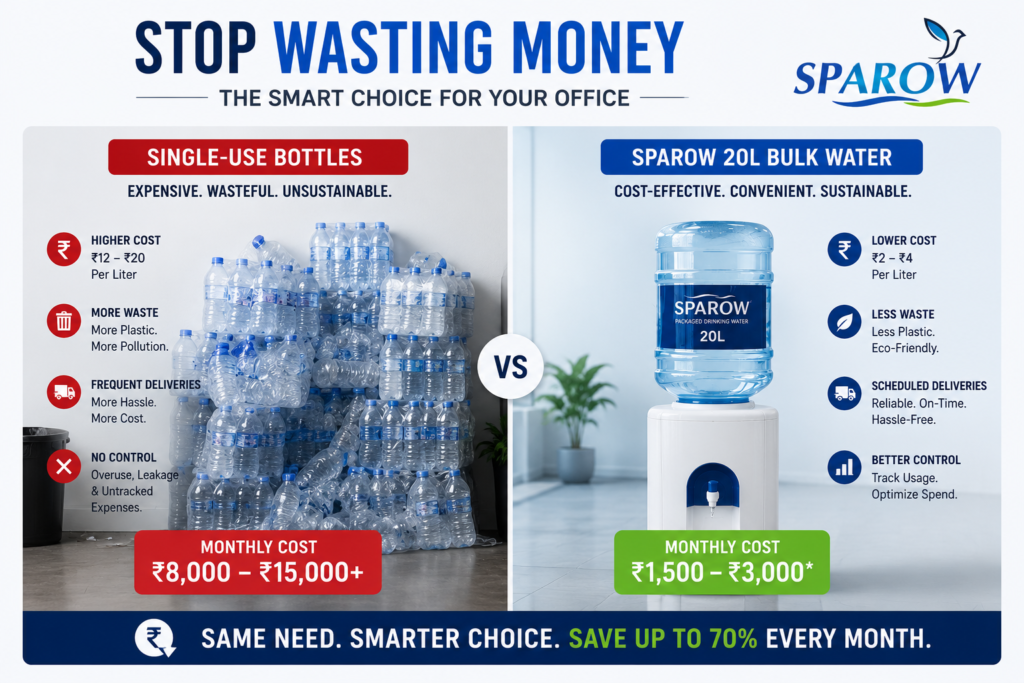
Even with a robust commercial RO system handling your daily pantry needs, boardroom meetings, VIP guests, and corporate events require a more sophisticated touch. For these high-profile moments, Sparow offers premium packaged drinking water that perfectly balances quality and local pride. Purified right here in Tirunelveli, our water is packaged in a highly practical, standard round PET design, ensuring a sleek, cost-effective, and professional presentation that leaves a lasting impression on your clients.
Provide high-quality, reusable drinking vessels nearby. Stack clean stainless steel or copper tumblers right next to the dispenser. Removing friction is the best way to increase daily water intake.
Step-by-Step: Implementing Your Office Water Consumption Guide
Transitioning to a better hydration strategy requires a bit of planning. You cannot simply cancel your old can vendor without a new RO system ready to go. Follow these exact steps to ensure a smooth transition.
First, audit your current usage by looking at the last six months of water bills. Calculate your exact cost per litre using the formulas provided earlier. This gives you a financial baseline to measure against.
Step 2: Survey Your Staff
Send out a brief survey to your employees. Ask them if they prefer room temperature, cold, or hot water functionality. Find out if they have concerns about the current water’s taste or accessibility.
This data will help you choose the features for your next commercial RO cooler. It also shows your team that management actively cares about their daily comfort.
Step 3: Source Local Vendors in South Tamil Nadu
Once you know your consumption rates in litres, contact three different local RO vendors. Ask them for quotes on commercial systems designed for high TDS water (e.g., 50 Litres Per Hour capacities). Make sure you reference your newly created office water consumption guide to show them you know exactly what you need.
Do not accept their first offer. Use the quotes to negotiate better rates on equipment rentals or preventative AMC schedules.
Sustainable Hydration Practices
Modern businesses in Tamil Nadu are under increasing pressure to adopt environmentally friendly practices. Your corporate water strategy is an excellent place to start going green. Traditional 20-litre delivery systems have a surprisingly large carbon footprint.
Delivery mini-trucks emit heavy greenhouse gases while hauling heavy water across city traffic. Furthermore, the thick plastic bubble tops degrade over time and contribute to plastic pollution. Transitioning to a bottleless RO system eliminates these environmental burdens entirely.
By filtering your own municipal or borewell water on-site, you achieve zero-mile delivery. It is one of the fastest ways to reduce your company’s carbon footprint.
Eliminating Single-Use PET Plastics
Never provide single-use PET plastic water bottles in the office fridge for meetings or guests. They are incredibly expensive per litre and terrible for the environment. A strict ban on single-use plastics should be explicitly written into your office water consumption guide.
Instead, gift every new hire a high-quality, branded copper or stainless steel water bottle. This builds company pride while simultaneously reducing plastic waste. It is a small upfront investment that pays massive environmental dividends.
Conclusion
Managing your workplace hydration does not have to be an expensive or frustrating chore. By understanding the numbers, you take total control over your facility’s budget. You stop overpaying for logistics and start investing in pure, safe hydration.
We highly recommend transitioning away from cumbersome 20-litre can deliveries, especially in areas with questionable ground water quality. Modern commercial RO coolers offer safer water, lower costs, and an infinite supply. They are the smart choice for any growing business in South Tamil Nadu.
Use this office water consumption guide to audit your current bills this week. Calculate your true baseline in litres, survey your staff, and start sourcing modern RO alternatives. A healthier, more productive, and well-hydrated team is just a few steps away.
FAQs
1. How many litres of water does the average office worker drink daily in South Tamil Nadu?
Given the hot and humid climate, the standard is roughly 2.5 litres per employee during an 8-hour workday. However, this can increase to 3.5 litres in non-AC environments or manufacturing units.
2. Should I include chai and filter coffee in my water calculations?
Yes. You should add a 20% buffer to your baseline employee calculations to account for hot beverages like filter coffee and chai, as well as visiting clients. Pantries use a surprising amount of filtered water for brewing.
3. Are commercial RO purifiers cheaper than 20-litre water can delivery?
Almost always. Commercial RO systems require a fixed annual maintenance contract (AMC) regardless of how many litres you consume. Can deliveries charge you per 20-litre unit, meaning costs scale up rapidly as your team grows.
4. Why is RO specifically needed in South Tamil Nadu?
Many districts like Madurai, Tirunelveli, and Thoothukudi suffer from highly saline groundwater. TDS (Total Dissolved Solids) levels frequently exceed 1,000 mg/litre. A robust commercial Reverse Osmosis (RO) system is required to bring this down to safe drinking levels.
5. How often should commercial RO filters be changed in an office?
For most commercial systems handling high TDS borewell water, pre-filters should be checked every 3 to 4 months. The main RO membrane typically lasts 1 to 2 years. A reputable local service provider will handle this through an AMC.
6. What is the ROI of following an office water consumption guide?
Implementing a strict guide often saves businesses 30% to 50% on their annual drinking water costs by eliminating the margins paid to delivery vendors. Furthermore, keeping employees adequately hydrated reduces sick days.
7. Do I need plumbing to install a bottleless RO cooler?
Yes. Bottleless RO coolers must be connected to your building’s existing raw water line and require a drainage line for the rejected water. However, commercial installers can usually run thin, flexible tubing discreetly to reach your pantry.
8. How do I stop employees from buying single-use plastic bottles?
The most effective method is providing a high-quality RO dispenser and gifting each employee a premium, reusable stainless steel or copper water bottle. Once you make the sustainable option the easiest option, behavior changes naturally.
9. Can we just boil tap water instead of using an RO?
Boiling kills bacteria but does not remove heavy metals, dissolved salts, or chemical impurities found in harsh groundwater. A commercial RO system provides comprehensive purification and is much more practical for large offices.
10. Who should manage the office water supply?
Typically, the office manager, facilities manager, or admin coordinator handles this responsibility. Armed with this office water consumption guide, they can easily forecast costs and coordinate AMC maintenance with local vendors.
Regional Resources & Regulatory References
To learn more about water quality standards, commercial guidelines, and groundwater reports specific to South Tamil Nadu, please refer to the following authoritative organizations:
- Bureau of Indian Standards (BIS) – Southern Regional Office
- Why it matters: BIS governs the mandatory quality standards and ISI certification (IS 14543) for all packaged drinking water manufactured and sold in India. Verifying a supplier’s BIS certification ensures the water meets stringent national safety protocols.
- Food Safety and Standards Authority of India (FSSAI) – Tamil Nadu
- Why it matters: FSSAI oversees the safety and hygiene compliance of all food and beverage businesses in the state. Every legitimate office drinking water vendor and bottling plant operating in Tirunelveli, Madurai, and surrounding southern districts must carry a valid FSSAI license.
- Tamil Nadu Water Supply and Drainage Board (TWAD)
- Why it matters: TWAD is the primary public agency responsible for water supply and sewerage facilities across Tamil Nadu (excluding the Chennai Metropolitan Area). Their Madurai Regional headquarters oversees the water infrastructure for South TN districts, including Tirunelveli, Kanyakumari, and Thoothukudi.
- Central Ground Water Board (CGWB) – South Eastern Coastal Region
- Why it matters: For businesses looking to understand the environmental impact and source of their water, the CGWB provides detailed, scientific district-wise groundwater brochures and quality reports for the southern regions of Tamil Nadu.
RD REIGROW PRIVATE LIMITED, Sole Manufacturer of Sparow packaged Drinking Water.